Episode 217: The Murder of Mary Bean
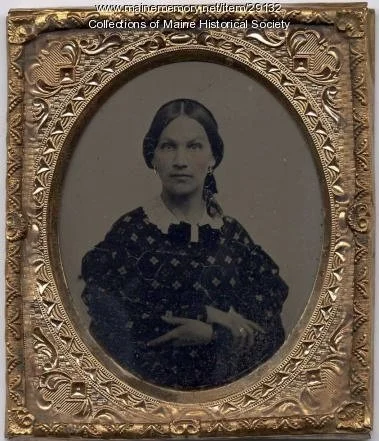
A possible photo of Berengera Caswell

On April 13th, 1850, 14-year-old Osgood Stevens was helping his neighbor clear a stream in Saco, Maine that had become dammed up with debris. After struggling with a plank of wood that had gotten stuck, Osgood managed to free the plank and then cried out for help. Tied to the plank of wood was the body of a woman. As Osgood and the neighbor called for help, a crowd gathered and people ran to get the town constable as well as the coroner. The young woman was wearing a nightgown and blue stockings and over her dark hair was a nightcap. Her face was concealed by an apron that a child would wear, and once the apron was pulled away onlookers were horrified to see that her face had been partially eaten by rats. Due to this and being submerged in the water for an unknown amount of time, the woman’s body was in rough shape.
Despite the damage to the woman’s face, several people were able to identify her by her jet black hair and give her a name: Mary Bean. Mary had been living with Dr. James Harvey Smith, who was confronted after the plank of wood Mary’s body was tied to was found to match the wood used in James Smith’s stable. When confronted, townspeople discovered that their theory was correct when there was a very obviously missing plank of wood from the stable. Dr. James Smith had moved to the Saco, Maine area along with many others as part of the factory boom that was quickly growing the area’s population. The population of Saco and nearby Biddeford had doubled from 1840 to 1850 as a result of the factories providing thousands of jobs. Dr. Smith was a botanical doctor, using herbal remedies and tinctures for various ailments which in his case included giving young women in need herbal remedies for abortions.
Three days after the autopsy and the burial of her body, Mary’s body was recovered so that doctors could further examine her for a cause of death. They specifically removed her reproductive organs, preserved them, and then buried her a second time. Dr. Smith was questioned about whether he had provided Mary with an abortion, and when he admitted that the girl had been living in his home but not for obtaining an abortion, he claimed she died of typhoid. As authorities worked to determine a cause of death and piece together what had happened, they also tried tracking down anyone who knew her. 21-year-old William Long came forward and said that he had reached out to Dr. Smith months ago in the fall about providing an abortion to his lover, but her name was not Mary Bean. William’s girlfriend, Berengera Caswell, was given the alias Mary Bean by Dr. Smith.
William was working as a machinist in the Saco factories, and when Berengera came to him about being pregnant, his supervisor had loaned him $10 for an abortion and connected him with Dr. Smith to provide one. Berengera was what was called a factory girl, or a young woman who had traveled to work in the factories to make an income for herself and send money back to her family. Factory girls were a major part of the workforce in textile mills, especially from the 1830’s-1850’s, and these mills were actively hiring and recruiting young girls and women who were teenagers and into their early twenties. As it was so rare to have an opportunity to work and earn money as a woman, especially a young woman, this led to these girls having freedom that was unprecedented. Despite reassurances to their families that they would be kept under strict rules, factory girls developed a reputation in society as they were negatively viewed for the amount of freedom they had and their ability to make their own money.
Berengera had traveled from Brompton, Quebec to Lowell, Massachusetts with her two sisters, Ruth and Thais. Lowell was another major factory town and young women traveled from all over to work in their textile mills. Ruth ended up meeting a man and getting married, staying in Lowell while Berengera and Thais moved on to another work opportunity at the Amoskeag Mills in Manchester, New Hampshire. William was working in the machine shop at the mill, and he and Berengera fell in love and began seeing one another over the course of the summer of 1849. In September, William was fired from his job at the Manchester mills and moved back to Biddeford, Maine where he had grown up. A week later, Berengera too moved out of Manchester and down to Salem, Massachusetts. Two months later in November, she realized that she was pregnant. She also realized she needed to find William for help, so she left Salem in search of him. Berengera moved into a room at a Biddeford, Maine boarding house on November 26th, 1849, and soon found William working for Saco Water Power Company.
Not wanting to pressure Berengera into marriage and also not wanting her turned away from society with an illegitimate child, William went to his manager for advice. His manager reassured William that he had a third option and pointed him in the direction of Dr. Smith. William brought Berengera to the doctor’s home on Storer Street in Saco, and Berengera moved in so that he could provide the abortion as privately and discreetly as possible. As he was a botanical doctor, he tried giving her herbal remedies on two separate occasions without success. On December 15th, 1849, Dr. Smith began attempting a surgical abortion, which he was likely not trained in, and when he inserted an eight-inch tool with a hook to puncture the amniotic sac and scrape out her uterus he punctured the uterine wall with a deep, four inch laceration. The procedure as well as the resulting severe infection were incredibly painful, and Berengera died a week later on December 22nd.
Panicking and wanting to avoid being charged with murder, Dr. Smith removed a plank of wood from his stable and tied Berengera’s body to it before lowering it into Woodbury Brook that ran just near his property. The brook connected to the large and powerful Saco River that eventually emptied into the ocean, and Dr. Smith thought Berengera’s body would be carried out to sea. What he did not take into account was that the plank would not travel straight down the stream and that it would get caught in a culvert under Storer Street, the same street he lived on, leading to the discovery of Berengera’s body less than four months later.
After it was discovered that Berengera did not die of typhoid but from an abortion, over 600 spectators piled into a meeting room to watch the coroner’s inquest and the subsequent trial. Once it was determined that Berengera had died of an abortion, specifically from inflammation and an infection caused by the abortion, the inquest was essentially repeated during Dr. Smith’s trial in January of 1851. Doctors testified about Berengera’s body and the laceration found on her uterus, neighbors reported seeing Berengera as well as other young women going to the doctor’s home, and William confirmed that he brought Berengera to the doctor for help with an abortion. Berengera’s sister Thais also testified as she had crucially identified some of Berengera’s clothing, jewelry and belongings at Dr. Smith’s house. There was a lot of emphasis placed on Berengera’s clothing and jewelry as these were shown to try to prove that she was spending her earnings on herself and frivolous things, suggesting that she was much too independent and bringing into question her character.
An employee of Dr. Smith’s, 12-year-old Irish immigrant Ann Covney, testified witnessing with her own eyes Dr. Smith use tools to give the surgical abortion to Berengera as well as multiple other girls and young women after herbal remedies failed. Dr. Smith was found guilty of second-degree murder and was sentenced to life in prison. His attorney appealed the verdict as Maine’s laws against abortions left a lot of loopholes, and the murder verdict was overturned and the sentence was reduced to manslaughter. As Dr. Smith had been in prison during the appeal and served more than enough time for a manslaughter charge, he was released. He died three years later from tuberculosis.
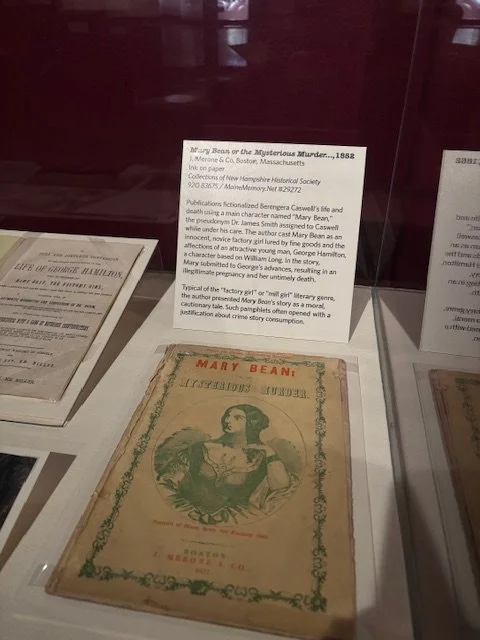
Berengera’s sister Thais had wanted to take her body to Quebec, but as this was much too difficult to arrange, she was buried in Manchester, New Hampshire. Berengera’s death and the trial reached across New England, and those who turned their noses up at the notion of factory girls used her death as confirmation that women should focus on marriage and leave the factories as soon as they found a husband, or not work in them altogether as they risked being shunned by society, sickness or even death. Several fictional books were written based Berengera’s case shortly after the trial, using her given alias of Mary Bean. Mary Bean became an exaggerated example and cautionary tale of what could happen to women if they pursued independence and freedom. Elizabeth De Wolfe, a History professor at University of New England in Biddeford, Maine, learned of Berengera’s murder when she saw the two fictional books written about it in her husband’s bookstore. She wrote her own book in 2007, a beautifully written nonfiction book titled “The Murder of Mary Bean and Other Stories.”
Image sources:
Photos taken by Katie from Maine Historical Society’s exhibit “Notorious: Maine Crime in the Public Eye 1690-1940”
mainememory.net - “The Murder of Mary Bean”