Episode 220: Franklin B. Evans
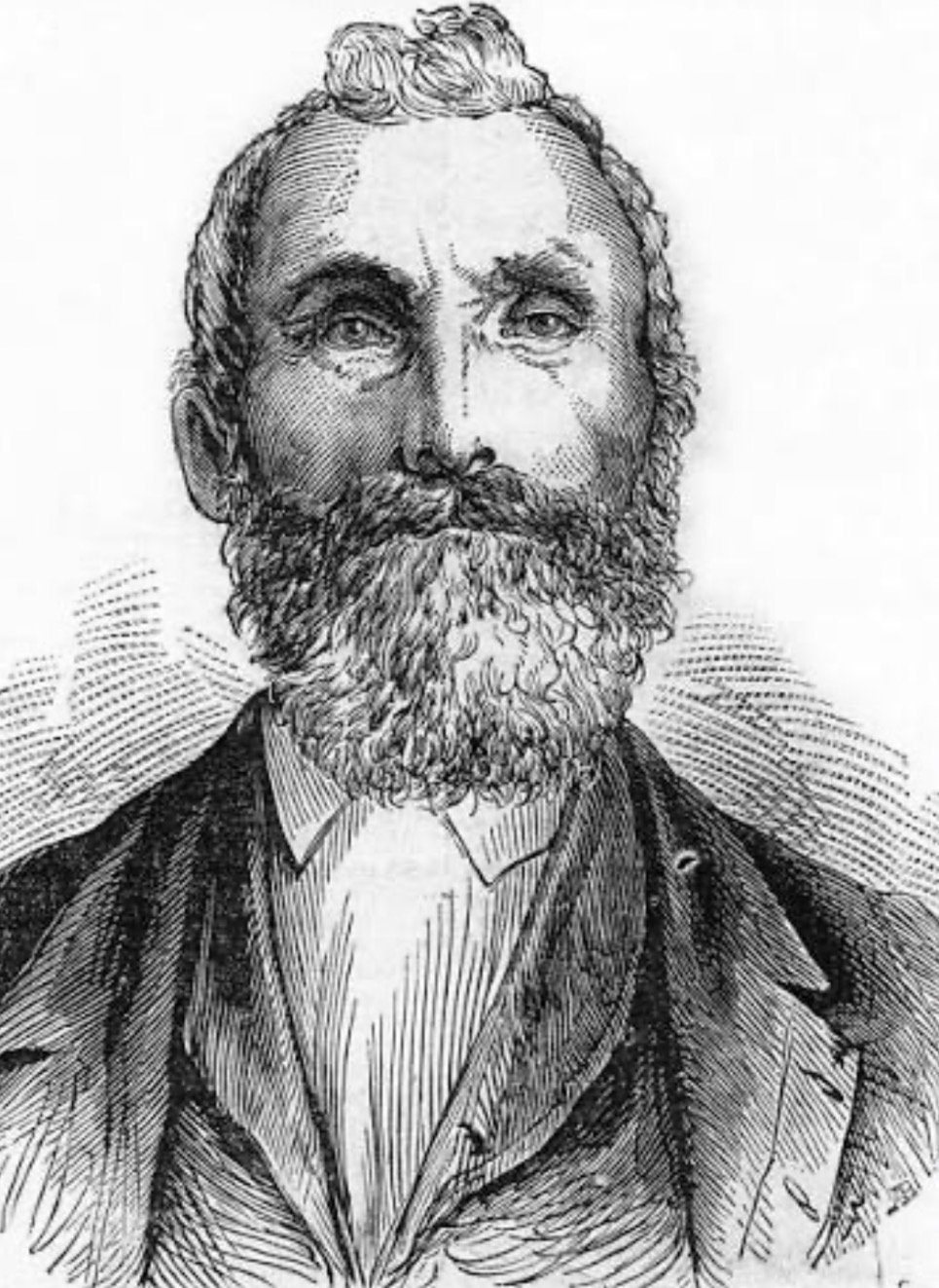
Franklin B. Evans, also known as the Northwood Murderer, is a historical murderer and suspected serial killer. He was born in Strafford, New Hampshire in 1807 and moved all over the state and New England region throughout his life, especially in his young adulthood. Franklin was known as being very odd and eccentric, never staying in one place for too long and developing a wide range of hobbies that all seemed to boil down to one thing: conning people. He was described in a newspaper article at the time as “cunning, shrewd and unprincipled.” Franklin referred to himself as a botanical doctor, or a doctor who specialized in herbal medicine and remedies, but he simply made his own concoctions to sell as he lacked any medical knowledge or training. He was said to travel with an electrical battery he claimed to use for healing ailments as well.
At times Franklin claimed he was a magician, while other times he borrowed money from family members and his adult children. At one time he got into serious legal trouble when he attempted a life insurance fraud scheme, trying to get $1,500 from the Traveler’s Insurance Company of Boston. Franklin had three wives, two who ended up leaving him and the last who died. He had a son and a daughter with just one of his wives. A string of murders around New Hampshire and sprinkled across New England at first didn’t seem to be connected, but the very last seemed to connect Franklin to all of them.
On October 25th, 1872, 13-year-old Georgianna Lovering disappeared from her Northwood, New Hampshire home. When she went missing, all eyes turned to the man who was caught multiple times making “improper advances” on her: her great uncle, 64-year-old Franklin B. Evans. Franklin’s travels had mostly come to an end as he had gotten older and he had moved in with his sister and her husband Sylvester Day in their Northwood, New Hampshire home. Their granddaughter Georgianna was staying with them, and she had grown quite fond of watching Franklin go into the woods to set snares to catch partridges as she was enamored with the beautiful birds. On the day of her disappearance, Franklin asked her to go into the woods near the home alone to check the snares he had set so that he could go to work on a nearby farm.
When she never came home and it was getting dark, the family started frantically searching for her and found her apron and her comb that had been broken on the ground on the outskirts of the woods. The next day, over a hundred people were searching in the woods for the girl. Franklin was immediately seen as suspicious and a warrant was issued two days after the disappearance. Inside of his pockets was “a wallet, money, obscene books, a bottle of liquor, and a common bone-handled knife with two blades, blood-stained and keen as a razor.” After extensive questioning by local Sheriff Henry Drew, Franklin claimed that Georgianna was alive and promised to tell him where she was in exchange for his own safety. Franklin claimed that he helped a man from Kingston, New Hampshire named Aaron Webster kidnap Georgianna to be his bride, but when Sheriff Drew took Franklin there the next day to look for her, there was no sign of the girl or this man named Aaron Webster.
Franklin claimed he made a mistake with the name of the town, but Sheriff Drew had enough and placed Franklin under house arrest. That night, Sheriff Drew asked Franklin, “In the hearing of no persons but us two and the Great Being above, I ask you this question: Is the body of the girl cold in death?” Franklin replied by saying, “It is, Mr. Drew. I have done wrong.” In the dark, Franklin then led Sheriff Drew as well as two other men from the town through the woods, through a swamp, and to a fallen tree where Georgianna’s body had been placed and then covered with leaves. By lantern light, the sheriff was able to see that Georgianna had been strangled as there were bruises in the shape of fingerprints around her neck. Her abdomen was also mutilated and sliced open where her reproductive organs and some of her bladder had been cut out.
The trial for Georgianna’s murder started on February 3rd, 1863, and after trying to hang himself with his suspenders on the second day of the trial, Franklin tried pleading not guilty by reason of insanity. This failed to work and he was found guilty. Franklin was sentenced to death by hanging with the execution planned for the following year. As it got closer to the date of his execution, authorities from around New England visited him in prison to try to connect him to other murders where he was found to have been in the area.
On October 30th, 1850, one of the 5-year-old twin girls of the Mills family went missing from her Derry, New Hampshire home after she and her twin sister had been left home alone. Even though her parents thought they were safe and secure inside of the home, someone had climbed into the home through a window and taken her. Her father Stephen Mills was devastated and offered up a $100 reward, all he could afford, for her safe return. The 5-year-old was never found. Franklin was living in nearby Salem, New Hampshire at the time with his second wife, and she had left him shortly before the little girl went missing. Franklin admitted to Sheriff Drew that he had kidnapped her, claiming that he had climbed into a window to get inside as he heard the girl moaning and that she was very sick. He felt that she would die before morning and he wanted to surgically examine her body, so he carried her out of the home and into the woods to strangle her. When he found that she had a deformed spine and hip, he then buried the body in the woods under a chestnut stump. Franklin claims he wasn’t ever able to find the location of the stump to retrieve her body, but it was rumored that he sold the skeleton to a doctor in Lawrence, Massachusetts two years after the little girl’s abduction.
Three years after the 5-year-old’s abduction, while Franklin was in Augusta, Maine, 14-year-old Anna Sibley went missing while on her way to school. Her body was found deep in the woods under a pile of leaves. Her throat had been cut and she had also been sexually assaulted.
Over a decade later on September 14th, 1862, 9-year-old Lura Ville Libby left her home in Strong, Maine to walk by herself to the town’s church service. When she never made it home, the town began putting together a search party for her and made the disturbing discovery the next day of her body in the woods just a half mile from her home. Her dress was torn from her body and she was covered in bruises. Her throat was slashed so severely that she was almost decapitated and she had been sexually assaulted. Her family’s farmhand, an Irish immigrant named Lawrence Doyle, was quickly viewed as the suspect as he had asked Lura’s father if he was going to walk her to and from church on the day of her murder. At the coroner’s inquest, a man from the town said that Lawrence had told him about a similar murder in Canada where the victim’s body was found in almost the same manner as Lura’s. Lawrence was brought to trial for the murder, and when the first one ended in a hung jury with five jurors voting on his innocence and seven voting on his conviction, he was put through a second trial. Here, the jury unanimously agreed that Lawrence was guilty and he was sentenced to the death penalty by hanging.
His attorney E. F. Pillsbury knew that Lawrence was innocent and he got the governor to change the death sentence to life in prison. Lawrence sadly died in prison just two years later, but his attorney vowed to not rest until he had proven his innocence. Franklin, who by this time had moved onto his next shady business venture as an Adventist preacher, was preaching in the nearby town of Augusta, Maine when Lura was murdered. Franklin was known for conning his way through sermons and urging people to make donations that he would use on things like sex workers in brothels and on one occasion a meerschaum pipe. He would move around often, preaching around New England to avoid getting caught for being a fraud and spending money on himself. Sheriff Drew asked Franklin if he had ever gotten in trouble in Maine, and he said that he had somewhere near Augusta and that a little girl had her throat slashed there around that time. Attorney E. F. Pillsbury, who was determined to exonerate Lawrence Doyle even after his death, was convinced that Franklin was responsible for Lura Libby’s murder as there were aspects of the crime not reported by newspapers that Franklin knew.
On June 12th, 1865, 12-year-old John and 14-year-old Isabella Joyce were last seen leaving their grandmother’s Boston home in a horse car to nearby May’s Woods, a popular park and recreation area, to collect branches and plants to make wreaths. The siblings accidentally took the trolley to the end of the line to Roxbury, Massachusetts, and their bodies were found in Bussey’s Woods on the following Sunday, June 18th. Both children were fatally stabbed with Isabella having sustained 27 stab wounds in her abdomen and 16 in her neck. It was also found that the first finger of her right hand was completely severed and her hand was badly damaged, showing she had grabbed the knife in a desperate attempt to fight back. Grass was shoved into her mouth and down her throat, likely to keep her from screaming. She was also sexually assaulted.
John was found a bit of distance away from Isabella, likely having tried to run away from the attacker. He was found face down with multiple stab wounds in the back and he had been badly beaten. There were several stab marks in the dirt underneath him from where the attacker had stabbed all the way through his little body. There were multiple suspects in the murders, but all were eventually ruled out. In December of 1866, a man’s skeleton was found in nearby Needham Woods outside of Boston along with some long, dark hair that matched the description of a man with long, dark hair seen lurking in Bussey’s Woods on the day of the murders. It was determined that the skeletal remains must be the remains of the man responsible, so the case was closed. Franklin Evans was also described as having long, dark hair, and it turns out that he was preaching around the Boston area at this time. After the murders, he moved out of the Boston area and back to New Hampshire.
When asked about his possible involvement with the murders of John and Isabella Joyce, Franklin told Sheriff Drew, “Mr. Drew, I was right there when that boy and girl were killed.” He then proceeded to tell the sheriff that both children were stabbed and that the girl was raped before she was fatally stabbed.
A newspaper reporter who was investigating the murders of John and Isabella Joyce had interviewed a woman from Boston who was visiting her friends in Roxbury when the children went missing. The woman was walking in the woods when she was startled by a man who she described as looking haggard, and the man had asked her if there was any evergreen nearby. The man had startled her, causing her to scream as his appearance scared her. When the reporter showed the woman photos of several men, one of Franklin B. Evans, “she immediately, unhesitantly identified it as the portrait of the man who had so frightened her.”
In May of 1872, just weeks before arriving at his sister’s home in Northwood, a young woman was raped and murdered in the woods near Fitchburg, Massachusetts where Franklin was conveniently traveling near.
Sheriff Drew realized that a lot of the murders took place in wooded areas, and Franklin was frequently in the woods looking for plants and flora to use in his herbal remedies as a self proclaimed botanical doctor. Of all the murders where Franklin happened to be in the area at the time, he only confessed to Georgianna’s and the 5-year-old girl’s.
On February 17th, 1874, Franklin B. Evans was hanged at the New Hampshire State Prison in Concord. It took him twenty agonizing minutes to die once suspended in the gallows. Before his death, Franklin had requested that his body be sold to Dartmouth College’s anatomical division so that they could dissect and study it and that the money for his body be given to his son. After the execution, his body was sent to Dartmouth later that same day per his wishes.
Image sources:
wikipedia.org - “Franklin B. Evans”