Episode 223: The Disappearance of Jessie Hoover

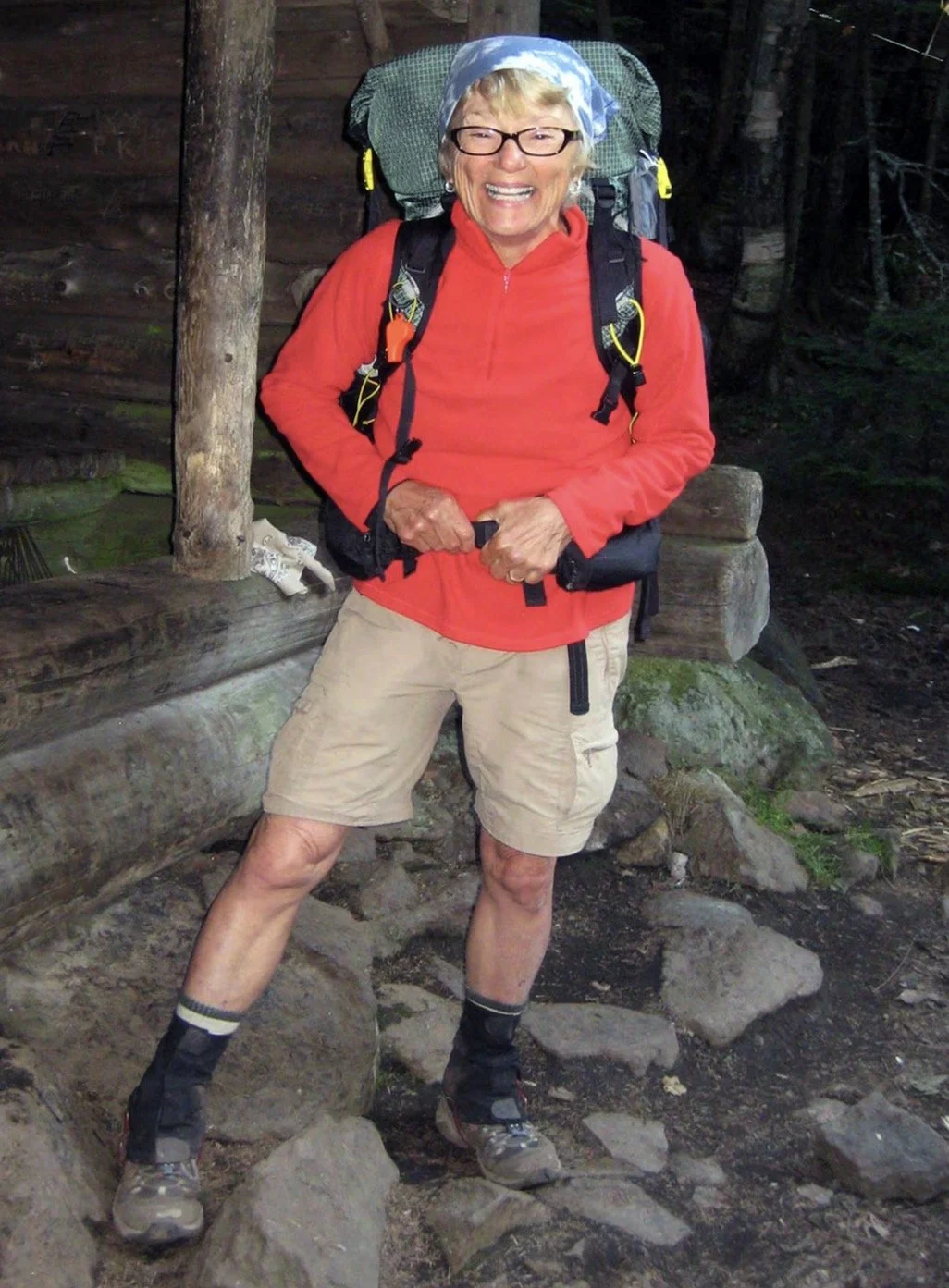
66-year-old Geraldine Largay
54-year-old Jessie Albertine Hoover was a kind and adventurous woman who lived in White Settlement, Texas. Her husband had died suddenly and tragically in 1982 after 35 years of marriage, and Jessie took his death hard. As he had passed away and her children were all into adulthood, it seemed like she wanted a new adventure and a change of pace. She had read about the Appalachian Trail in a National Geographic article and was so inspired to do this herself that she traveled to Maine to start the hike in May of 1983. The Appalachian Trail extends from Maine to Georgia, passing through 14 states and extending almost 2,200 miles. It typically takes about five to seven months to complete with most people starting in Georgia and traveling north to Maine to follow the warmer weather.
The New England stretch of the trail has a lot of challenges, with the New Hampshire stretch being especially difficult with almost the entire portion being in the White Mountain National Forest. Per the Appalachian Trail Conservancy, New Hampshire has more trail above tree-line than any other Appalachian State. This stretch also includes Mount Washington, which is known for having some of the most extreme weather in the world with weather conditions changing in an instant, high wind speeds and a risk of snow year round. The most remote section, referred to as the 100-Mile Wilderness, is in Maine between Monson and Abol Bridge. A famous warning sign near Abol Bridge reads, “Do not attempt this section unless you have a minimum of 10 days supplies and are fully equipped. This is the longest wilderness section of the entire AT and its difficultly should not be underestimated.”
Among other challenges she faced, Jessie had a seizure disorder called epilepsy that she managed with medications. She was not an experienced hiker and seemed ill prepared for the trip, but to reassure her family she set up a plan with her doctor to pick up her medication in various towns along the way. Jessie also had a stack of postcards she planned to send her family along the way and promised to call whenever possible. For money, her plan was to wire money from home when she stopped in different towns. While her family was nervous, Jessie was excited and very determined.
She last spoke to her daughter Mary on May 16th, 1983 after Jessie called her from a motel in Bangor, Maine. Jessie said she had made it to Maine and would be headed to Millinocket to officially start the Appalachian Trail. She was last seen four days later on May 20th, 1983. She had been at the Baxter State Park headquarters in Millinocket, Maine trying to obtain a permit to hike Mount Katahdin. Park rangers told her they were concerned with her lack of gear and they did not issue her the permit because they did not feel as though she was prepared to safely make the hike. Mount Katahdin is the highest peak in Maine, and like Mount Washington, is known for having dramatic changes in weather conditions. In addition to not being familiar with the area, Jessie also wasn’t very familiar with hiking in general. She did not have any kind of equipment with her and she had about $15-$20 cash. All she had on her person for food was beef jerky despite being just outside of the 100-Mile Wilderness with no opportunity to stop to get more food and other supplies.
As the start of the Appalachian Trail heading southbound was at Mount Katahdin, Jessie was determined to do what she had set out to do and persisted. After the rangers denied her permit, she was spotted at the trailhead of the 100-Mile Wilderness. There was a gate tender who remembered seeing Jessie coming through Golden Road near Abol Bridge, which is another way to enter the Appalachian Trail. That day, temperatures were in the high 60’s and got up to 72 degrees, but that night, especially at higher elevations, temperatures dropped into the 30’s with rainy conditions. Rangers had warned of the risk for hypothermia. Jessie’s sister reported her missing almost two months later on July 11th, 1983, after Jessie didn’t make contact with her or her family and hadn’t wired home for money as planned.
David Sewall, a retired sergeant with the Maine Game Wardens who investigated the disappearance, stated, “What had happened is that this Jessie Hoover had lost her husband and she was very depressed, so her family tells me, and she decided that she would hike the Appalachian Trail. Now, here is a lady who is … obviously overweight, absolutely nothing for equipment. She takes a bus in from Boston to Millinocket, then she gets a taxi to take her up to Baxter. She wants to start at the top of the mountain and they refuse her because she’s not equipped for it. So now, she takes a taxi to get up to Abol Bridge, which is out of the park but the Appalachian Trail crosses there. The gate tender remembers [her] but then she starts into the woods and that was the last anybody saw her.” Massive searches turned up no leads, but the terrain was frustrating with how dense it was and with how easily someone could unknowingly wander off the trail. Along with her lack of supplies, authorities were concerned with Jessie’s seizure disorder.
Her disappearance unfortunately didn’t get a lot of media coverage, but the disappearance of another hiker on the Appalachian Trail in Maine helped shed a little more light on the case. 66-year-old Geraldine Largay, lovingly nicknamed Gerry, was a retired air force nurse as well as a veteran who was adventurous and wanted to make the most of her retirement while still being very active. She was from Tennessee and was no stranger to hiking, frequenting the longer trails in her home state. Before embarking on the Appalachian Trail, she had taken a course about it to know exactly what to expect and how best to be prepared. She started hiking the Appalachian Trail with a friend, but when her friend had to leave in June of 2013 due to an emergency, Gerry persisted with the help of her husband George. He was driving along the route to meet her at different stops to resupply her with food and essentials.
Gerry was last seen on July 22nd, 2013 at the Poplar Ridge lean-to on the Appalachian Trail in Maine. It was one of many shelters along the trail that hikers could stay overnight in or just rest in for a few hours. Her plan that day was to hike eight miles to the Spaulding mountain lean-to, sleep there, then hike 13 miles to State Route 27 where she and George had arranged to meet. On July 24th, the agreed upon date for George and Gerry to meet, she didn’t show up and George waved down a police officer driving by for help. The search ended up being one of the largest in Maine’s history with multiple search helicopters being deployed to search from overhead, hundreds of volunteers and multiple police and fire departments searching and interviewing other hikers. Multiple teams of search dogs were dispatched as well with no leads.
Gerry’s body was found on October 14th, 2015 by a forester working for the US Navy. The man came across skeletal remains, and upon this discovery both Gerry’s family and Jessie’s family were wondering if the remains could belong to their loved one. The remains were confirmed to be Gerry’s, and her cause of death was determined to be from exposure. She had survived for 26 days before she died. It was determined that on July 22nd, 2013, the day she was last seen, Gerry had stepped off of the trail a little ways away to use the bathroom. When she was done, she took a wrong turn, got disoriented and couldn’t find her way back to the trail. Gerry attempted to text her husband multiple times, but none were ever delivered as she had no service. She tried locating the trail, finding higher ground for phone service, and making smoke signals to alert rescuers of her location.
In her journal, she wrote an entry dated for August 6th, 2013 stating, “When you find my body, please call my husband George and my daughter Kerry. It will be the greatest kindness for them to know that I am dead and where you found me – no matter how many years from now. Please find it in your heart to mail the contents of this bag to one of them.” With her skeletal remains, authorities found her journal as well as hiking gear that included maps, a flashlight that still worked, a blanket, as well as her baseball cap and a necklace. The camp was less than two miles from the Appalachian trail with “a clear logging road” that led to shelter about a 25 minute walk away. When the teams of search dogs were deployed, at least three of them came within 100 yards of the camp. The forest is so dense with poor visibility that it was impossible to see her or for Gerry to see the way out.
As for Jessie, she has not been seen or heard from since entering the Appalachian Trail. None of her belongings have been located. Of the other hikers on the Appalachian Trail questioned by police who were heading northbound and would have crossed paths with her, none said that they saw Jessie. Both her daughter Mary, who started a Facebook page to raise awareness about her mom’s disappearance, and her son Eugene have submitted their DNA to the National Missing and Unidentified Persons System, known as NamUs, so that their mom’s remains can be easily identified if they are found. They have also been connected to the Doe network, another organization that helps identify missing persons.
At the time of her disappearance, Jessie Hoover was 54-years-old with brown hair that was starting to turn grey and blue eyes. She was about 5’8”-5’10” and about 250lbs. She was last seen wearing a blue shirt, blue windbreaker jacket and blue jeans with a blue knapsack. She’s missing two of her bottom teeth.
Anyone with any information on the whereabouts of Jessie Hoover is asked to please call Maine State Police at (207) 973-3750.
Image sources:
wgme.com - “How a reporter unraveled the untold tale of missing AT hiker Jessie Hoover”
bostonglobe.com - “Hiker’s family decries reports that criticized her skills”