Episode 211: The Great Molasses Flood
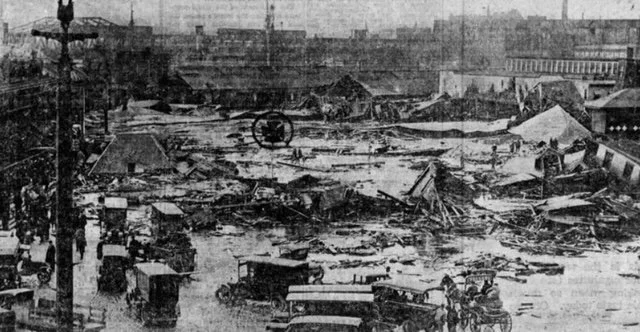
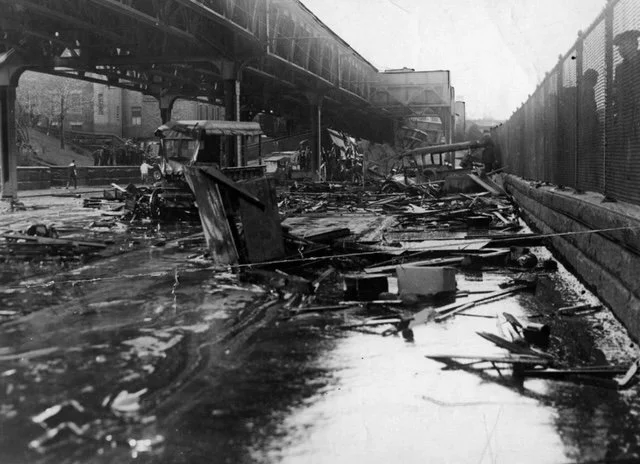
The weather on January 15th, 1919, was a little over 40 degrees and was unseasonably warm. It was a pleasant break from the otherwise brutally cold Boston winter, especially as the previous days had been below freezing. At around 1:00 p.m., Boston’s North End was filled with people walking around and workers taking advantage of the weather on their lunch breaks. People began to notice what sounded like one of the trains approaching, but everyone quickly picked up on the fact that the rumbling noise was growing louder and coming closer.
Four years ago in 1915, the Purity Distilling Company built a massive 50-feet tall, 90-feet wide tank next to the Boston Elevated Railroad tracks. The tank towered over the tracks and was used to store molasses. Tankers would bring in shipments of molasses to nearby Copps Hill Wharf, and the molasses would be pumped into the tank and kept in optimal conditions until it was loaded onto the train cars and sent to distilleries or sent through a pipeline to Purity’s ethanol plant in nearby Cambridge, Massachusetts. When fermented, molasses turns into ethanol, which is the active ingredient in alcoholic drinks. It also is used to make munitions, which were crucial for the ongoing World War 1.
To put the size of this tank into perspective, the tank held over two million gallons of molasses. While the tank was quite impressive, it was known to have some issues. For starters, it leaked. This became quite apparent to local residents because they could see and smell the molasses oozing from the seams of the tank. Children would take pails and collect molasses seeping out of the tank to then bring home for their parents to cook and bake with or to enjoy themselves as a treat. When residents alerted the Purity Distilling Company to this issue, rather than fix the tank, patch it up or rebuild, they simply painted the tank molasses brown to hide the fact that it was leaking. Molasses is by definition very thick and heavy, and the material of the tank itself wasn’t strong enough to hold it. The neighborhood surrounding the tank was a mostly Irish and Italian neighborhood of immigrants, and they were made to get used to the leaking as well as the frequent creaking sounds and groaning noises from the tank.
After four years of quite literally busting at the seams, and now on January 15th, 1919, the rapid fluctuation in temperature, plus a massive new shipment of fresh molasses, the tank exploded. The older molasses already in the tank was quite cold from the frigid temperatures of the days prior, but the new molasses that had just arrived the day before had been warmed to make it easier to pipe into the tank. The rumbling noise that people heard on that fateful day was the sound of 2.3 million gallons of molasses, weighing 12,000 metric tons, hurtling through Boston after the tank exploded at around 12:30 p.m.
There is a famous saying that we all may know that goes something like “slow as molasses.” After the walls of the tank burst, the tidal wave of molasses was so powerful that it traveled through the streets at 35 miles an hour. The rumbling could be felt as the ground shook, and people close to the explosion heard a massive bang along with what sounded like gunshots as the tank burst open. The wave of molasses was reportedly anywhere from 20 to 50 feet high. It was strong enough to push a train off of its tracks, move a firehouse and other nearby buildings completely off of their foundations, destroy other buildings completely, and encase people and animals in a thick, suffocating layer of molasses. Every surface of the impacted area was covered in a thick layer of sticky molasses, now mixed with debris from damaged or destroyed buildings and sharp debris from the tank itself. Six buildings were destroyed in the flood. The areas closest to the tank were covered in up to three feet of molasses.
People and animals, especially horses, became trapped in the sticky mess. An article from the time from the Boston Post stated, “Molasses, waist deep, covered the street and swirled and bubbled about the wreckage. Here and there struggled a form - whether it was animal or human being was impossible to tell. Only an upheaval, a thrashing about in the sticky mass, showed where any life was. Horses died like so many flies on sticky fly-paper. The more they struggled, the deeper in the mess they were ensnared. Human beings - men and women - suffered likewise.” 21 people were killed and over 150 were injured. 25 horses died in the flood as well.
The USS Nantucket, a training ship for what is now the Massachusetts Maritime Academy, had been docked nearby and responded to the explosion with 116 of the ship’s cadets arriving first on the scene. Boston police and the Boston Red Cross both responded quickly after, with people wading knee deep and even diving into the molasses to pull people out. Sailors from USS Nantucket had ran into a building that had been destroyed in the flood. Inside were two women, Elizabeth O'Brien and Mary Keenan, who were living in a second-floor apartment. After their building had been swept off of its foundation, a sailor climbed inside to look for survivors and helped rescue the women. Sailors also rescued a city employee named Patrick Breen, who had been knocked off his feet from the wave of molasses and thrown into the freezing water of the harbor. He survived initially, but had developed pneumonia and suffered from multiple broken ribs and an injured leg.
The Engine 31 firehouse, where the firefighters inside were eating lunch and playing cards, was knocked off its foundation and collapsed in on itself. Firefighters were rescued from inside a pocket on the first floor after hours of cutting away the floorboards above them, but one firefighter, 38-year-old George Layhe, tragically drowned in the molasses.
It became nearly impossible to remove debris, especially as it started to get colder outside. People worked well into the night as it dropped back into below freezing temperatures, taking pickaxes and chisels to the thickening molasses. Welders came together to use their welding tools and torches to help melt the molasses to make it easier to clear away to try and rescue victims trapped underneath. Fire hydrants were opened in an effort to wash the molasses away, but this was frustratingly ineffective. After a lot of hard work and trial and error, it was discovered by one of the firefighters that salt water broke down the sticky component of the molasses and made it much easier to clean off. The firehouse for Engine 31 was the firehouse completely swept off of its foundation, but as they were so close to the harbor, they had a fireboat. They were able to get this into the water and use their powerful hoses to spray saltwater on the sticky surfaces to make it easier for volunteers and first responders to clean up. Millions of gallons of saltwater were pumped from the harbor to clean up the area. It was also pumped into basements that became filled with molasses.
The harbor turned brown from molasses and stayed that way well into the summer months. Molasses was tracked on clothing and shoes around Boston, onto train cars, into shops and grocery stores, and into homes. The cleanup took over six months, and it was famously said that “Everything that a Bostonian touched was sticky.” People described every surface, even grab rails on the subway and pay phones, as having a thin, sticky layer of molasses.
Of the 21 people killed from the flood,10-year-old Pasquale Iantosca was the youngest victim. He had been home from school for lunch and was out gathering firewood with his friend, 8-year-old Antonio di Stasio and Antonio’s sister, 10-year-old Maria. Pasquale’s dad heard the tank explode and looked out of his window to see his son being swept away in the flood. Pasquale was slammed into a railroad car, killing him on impact. 10-year-old Maria died as well after she suffocated in the thick syrup. Antonio thankfully survived, but he sustained a serious head injury after the wave of molasses threw him into a light post.
Other victims of the molasses flood were:
64-year-old Peter Francis
44-year-old Patrick Breen
61-year-old William Brogan
43-year-old John Callahan
37-year-old Flaminio Gallerani
58-year-old William Duffy
48-year-old James Kenneally
32-year-old Cesare Nicolo
69-year-old John Seiberlich
78-year-old Michael Sinnott
17-year-old Eric Laird
64-year-old James Lennon
21-year-old Ralph Martin
46-year-old James McMullen
18-year-old Peter Shaughnessy
43-year-old Thomas Noonan
After the explosion, 119 Boston residents brought up a class-action lawsuit, one of the first in the state of Massachusetts, against the United States Industrial Alcohol Company. The company had purchased Purity Distilling in 1917, and their lack of accountability for any wrongdoing with the explosion was infuriating to victim’s families, survivors and Bostonians. The company later tried to claim that the tank had been intentionally blown up by anarchists, because one of the other uses for fermented molasses, known as ethanol, is to make munitions. At the time of the explosion, company attorney Harry F.R. Dolan had stated, “If there had been any indication of weakness in the structure, it would have been apparent to the two men who examined it twice that day.”
After three years of legal proceedings, in 1925, a court-appointed auditor found the United States Industrial Alcohol Company responsible for the explosion, the fatalities and the damages that resulted. The company paid out over $628,000 in damages, which is roughly $11.4 million dollars today. It was reported that relatives of victims who were killed received $7,000 for each loss, or $127,000 today. This was historical and greatly changed how industries were regulated. After the details of the court proceedings and the findings came out, architects for projects were asked to show their work to ensure safety, building inspectors began being required to check in on projects and engineers started being required to assess and sign project plans.
It is widely believed that the Purity Distilling Company overlooked safety concerns to make as much of a profit as possible before the prohibition. The 18th amendment for the prohibition of alcohol was ratified the day after the tragic explosion on January 16th, 1919.
A 2014 investigation found that the steel used for the tank was half as thick as it should have been, and the steel was chemically inadequate as it lacked manganese, making it brittle and weak. The tank also had flawed rivets, essentially huge screws keeping the tank’s seams closed, and it was found that the rivet holes had started to crack. In 2016, a team of Harvard scientists and students completed huge studies to research the molasses flood. They found that despite how wild it sounded, the reports of the molasses traveling at 35 miles an hour were credible.
For decades after the flood, people said they could smell molasses in the North End of Boston, especially on hot and humid summer days.
Image sources:
boston.com - “‘Masses of wreckage’: The painstaking cleanup and tragic aftermath of Boston’s Great Molasses Flood”